Welcome to Ayesha Dental Care Reg#: 7020-D

Blogs

Dr Ayesha Irfan Sethi
September 29, 2026How Long After a Tooth Extraction Can You Get an Implant: Complete Timeline for Different Clinical Scenarios
One of the most common questions patients ask after having a tooth pulled is simple: how soon can I get an implant? The honest answer is — it depends on your specific situation. The healing timeline for a dental implant isn't one-size-fits-all; it depends on why the tooth was removed, the condition of the bone underneath it, and whether any additional procedures are needed first. Here's a complete breakdown of the different clinical scenarios and what to realistically expect.
Why Timing Matters So Much
When a tooth is extracted, the jawbone that once supported it starts to remodel and, without intervention, gradually loses density and volume — a process called resorption. An implant needs enough solid, healthy bone around it to fuse properly (a process called osseointegration), so the timing of placement is really a balancing act between letting the site heal enough and not waiting so long that bone is lost unnecessarily.
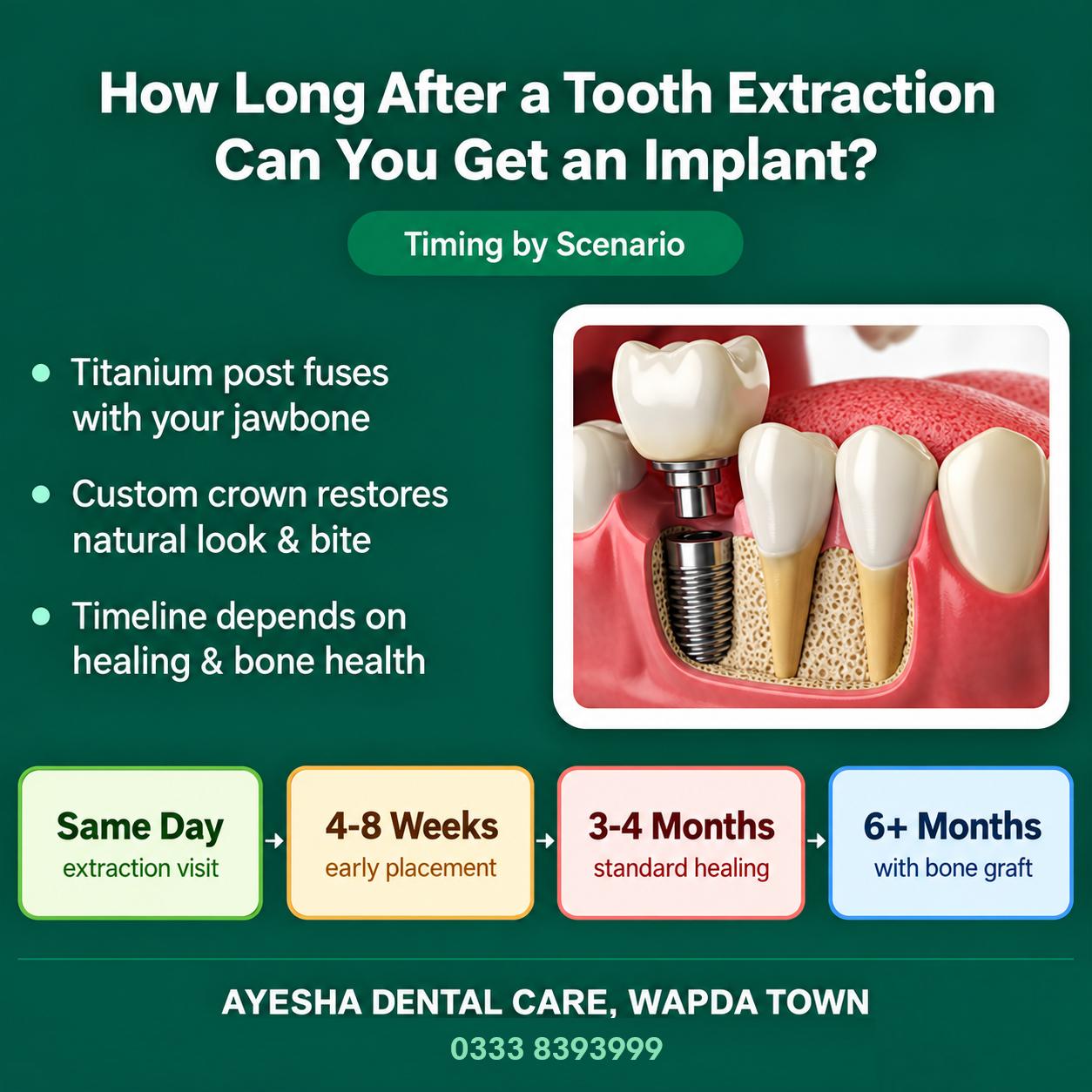
Scenario 1: Immediate Implant Placement (Same Day as Extraction)
In select cases, an implant can be placed in the same socket immediately after the tooth is removed — in one single appointment.
This works best when:
- There's no active infection at the extraction site
- The surrounding bone walls are intact and healthy
- The patient has good bone density and no major systemic risk factors
The advantage is fewer total procedures and less overall treatment time. The trade-off is a slightly higher technical demand on the clinician and, in some cases, a somewhat less predictable final aesthetic result compared to waiting for the socket to fully heal first.
Scenario 2: Early Implant Placement (Roughly 6–12 Weeks After Extraction)
This approach allows the soft tissue (gums) to heal over the socket first, while bone healing is still in its earlier stages.
Best suited for:
- Sites where there was mild infection or inflammation that has since resolved
- Cases needing slightly more predictable soft-tissue contouring, especially in visible areas like the front teeth
This middle-ground approach is often chosen when a dentist wants some of the time-saving benefit of early treatment without placing an implant into a completely fresh extraction site.
Scenario 3: Delayed (Conventional) Implant Placement (Roughly 3–6 Months After Extraction)
This is the most common and well-studied timeline, allowing the bone to substantially heal and remodel before the implant is placed.
Typically recommended when:
- The extraction site had a cyst, infection, or significant bone loss at the time of removal
- The patient needs more predictable, lower-risk healing before surgery
- Bone width and height need time to stabilize
By this point, the socket has generally filled in with new bone, giving the implant a solid, stable foundation — which is a major reason this remains the standard approach for many patients.
Scenario 4: Late Placement with Bone Grafting (6+ Months, Sometimes Longer)
If a tooth has been missing for a long time before treatment begins, or if the extraction site lost significant bone volume, a bone graft is often needed before an implant can be placed at all.
This route typically involves:
- Bone graft placement at (or after) the time of extraction
- A healing period of several months for the graft to integrate with existing bone
- Implant placement once adequate bone volume is confirmed, often with imaging
- Additional healing time before the final crown is attached
While this is the longest path, it's often the only way to achieve a stable, long-lasting result when bone has already been lost.
Factors That Can Extend Any Timeline
Regardless of which scenario applies to you, these factors can add time to the process:
- Smoking — significantly slows healing and increases implant failure risk
- Uncontrolled diabetes — impairs the body's ability to heal and fight infection
- Bone density in the specific jaw area — upper back teeth, near the sinus, often need extra planning
- Whether infection was present at extraction — active infection generally requires full healing before any implant work begins
- Overall oral hygiene and gum health
What This Means for Your Own Timeline
Because so much depends on individual anatomy and health history, there's really no substitute for an in-person evaluation with imaging (X-rays or a 3D scan) to determine which of these four scenarios applies to your case. A consultation is the only reliable way to get an actual timeline specific to your mouth, rather than a general estimate.
Conclusion
Whether you're a candidate for same-day implant placement or need a bone graft first, the most important thing is getting an accurate, personalized evaluation rather than guessing based on someone else's experience. If you've recently had a tooth extracted and are wondering what your options are, schedule a consultation to get a clear, individualized timeline and treatment plan.


